Are you experiencing frustrating errors related to opencl.dll on your Windows system? Whether your applications crash unexpectedly, you encounter startup failures, or receive error messages claiming that opencl.dll is missing or failed to load, you're not alone. These issues can disrupt your workflow, gaming experience, or system stability. This comprehensive guide will help you understand the role of opencl.dll, identify common problems, and apply effective troubleshooting and repair methods. Plus, you'll find practical prevention tips to minimize future errors and keep your system running smoothly.
Understanding opencl.dll and Its Role in Windows
What is opencl.dll?
opencl.dll is a Dynamic Link Library (DLL) file associated with the OpenCL (Open Computing Language) framework. OpenCL is an open standard for cross-platform parallel programming of CPUs, GPUs, and other processors. The opencl.dll file acts as a crucial interface that allows Windows and applications to utilize hardware acceleration for tasks such as graphics rendering, scientific computations, and video processing.
How opencl.dll Works in Windows
When you run applications that leverage hardware acceleration—like gaming engines, professional graphics software, or even some system utilities—they often rely on opencl.dll. It provides the necessary functions to facilitate communication between software and your graphics hardware. If this DLL is missing, corrupted, or incompatible, programs dependent on it can fail to start or crash.
Common Applications Using opencl.dll
- Gaming titles that require GPU acceleration
- Video editing and encoding software
- 3D modeling and rendering tools
- Certain drivers and system utilities that optimize hardware performance
Having a properly functioning
opencl.dllis vital for seamless multimedia and graphics performance.
Common Issues and Error Messages Related to opencl.dll
Error Messages and Their Meanings
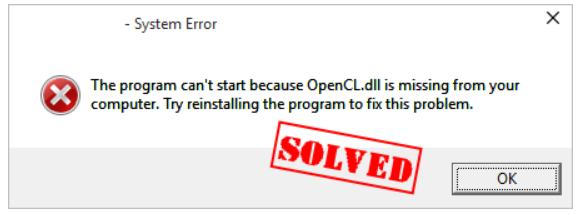
Users frequently encounter specific error messages involving opencl.dll:
- "Missing opencl.dll": Indicates that the DLL file is absent from system folders or has been accidentally deleted.
- "Failed to load opencl.dll": Suggests that the DLL exists but cannot be loaded, possibly due to corruption or incompatibility.
- "opencl.dll is missing" or "Cannot find opencl.dll": Similar to the first, pointing to a missing or misplaced file.
- "An error occurred loading opencl.dll": Often points to registration problems or damaged files.
Causes of opencl.dll Errors
Several factors can lead to these errors:
- Corrupted or outdated graphics drivers, especially those that include OpenCL components
- Accidental deletion of
opencl.dllduring system cleanup or malware removal - Malware or virus infections damaging DLL files
- Software conflicts, particularly incompatible or improperly installed applications
- System file corruption or Windows registry issues affecting DLL registration
- Hardware issues or driver updates that change DLL dependencies
Impact on System and Software
Missing or corrupted opencl.dll can cause:
- Application crashes or failure to launch
- Performance degradation in graphics-intensive applications
- Error prompts during startup
- System instability or, in severe cases, blue screen errors Understanding these issues is the first step toward effective troubleshooting.
Effective Troubleshooting and Fix Strategies
Resolving opencl.dll errors involves several methodical steps. Here’s a practical guide to diagnosing and fixing common problems.
Basic Troubleshooting Steps
- Restart Your Computer: Sometimes, a simple reboot can resolve temporary glitches.
- Check for Error Details: Note down the exact error message and any associated codes.
- Reinstall Affected Applications: If the error occurs when opening a specific program, reinstalling it might replace missing or corrupted DLL files.
Using System Files Checker (SFC) and Deployment Image Servicing and Management (DISM)
Corrupted system files can cause DLL issues. Use built-in Windows tools to repair them:
- Run Command Prompt as Administrator, then execute:
sfc /scannow
This command scans and repairs corrupted system files, including DLLs.
- To address deeper corruption, run:
DISM /Online /Cleanup-Image /RestoreHealth
Followed by rerunning sfc /scannow.
Updating Graphics Drivers
Since opencl.dll is tied to graphics hardware, updating your GPU drivers can resolve many issues:
1. Identify your graphics card model via Device Manager.
2. Visit the manufacturer's website (e.g., NVIDIA, AMD, Intel).
3. Download and install the latest driver versions.
4. Restart your system and check if the error persists.
Manual Repair Techniques for opencl.dll Errors
When automated tools don't fix the problem, manual intervention might be necessary.
Manual Replacement of opencl.dll
- Download the correct
opencl.dllfile from a reputable source or extract it from a clean driver package. - Locate the current
opencl.dllin your system (typically inC:\Windows\System32orSysWOW64for 64-bit systems). - Backup the existing DLL before replacing it.
- Copy the new
opencl.dllinto the appropriate directory. - Restart your PC and test the application.
Registering DLL Files with RegSvr32
Sometimes, registering the DLL can resolve loading issues: 1. Open Command Prompt as Administrator. 2. Execute:
regsvr32 opencl.dll
- Wait for confirmation message, then restart your system.
Restoring System Files
If the DLL is damaged beyond repair, restoring your system to an earlier restore point can help:
- Open System Restore from Control Panel.
- Select a restore point before the issue appeared.
- Follow on-screen instructions to complete the restore.
Preventing Future opencl.dll Errors
Prevention is always better than cure. Here are essential tips to keep your Windows system healthy and minimize DLL-related errors:
Regular System Updates
- Enable automatic Windows updates to keep your system and drivers current.
- Regularly install updates for graphics drivers and Windows patches.
Security and Virus Prevention
- Use reputable antivirus and anti-malware software.
- Perform scheduled scans to detect and remove threats that could damage DLL files.
Safe Software Installation Practices
- Download software only from trusted sources.
- Avoid installing incompatible or pirated programs.
- Always perform custom installs to deselect unwanted additional components.
Additional Tips
- Avoid manual editing of system files unless necessary.
- Maintain sufficient disk space for updates and system operations.
- Create periodic system backups to restore in case of errors.
Conclusion
Errors related to opencl.dll can disrupt your daily computing, especially if you're into gaming, graphic design, or scientific computing. Understanding its role in system functionality, identifying common error scenarios, and applying the right troubleshooting steps can effectively resolve these issues. Remember to keep your drivers up to date, perform regular system maintenance, and avoid risky software practices. If problems persist despite your efforts, consulting with a professional IT technician can help diagnose more complex hardware or software conflicts.
By following the strategies outlined in this guide, you can restore stability, enhance performance, and prevent future opencl.dll errors—keeping your system running smoothly and efficiently.
Always exercise caution when modifying DLL files or system settings. When in doubt, seek professional assistance to prevent further complications.