Introduction Experiencing errors related to ddraw.dll can be frustrating, especially if you are an avid gamer or rely on multimedia applications for work or entertainment. This dynamic link library (DLL) file plays a critical role in graphics rendering and game performance. When issues like missing, corrupted, or failed to load ddraw.dll pop up, they can cause applications to crash or refuse to launch altogether. Promptly resolving these errors is crucial to restoring system stability, ensuring smooth gameplay, and maintaining overall performance. This guide will walk you through understanding ddraw.dll, diagnosing common errors, and applying effective manual fixes, along with tips to prevent future issues.
Understanding ddraw.dll and Its Role in Windows
DLL Fundamentals
DLL files are shared libraries used by Windows applications to execute common functions without embedding the entire code within each program. This modular approach enhances efficiency and simplifies updates. ddraw.dll is one such dynamic link library linked to DirectDraw, a component of Microsoft DirectX, which handles 2D graphics rendering such as drawing images, textures, and sprites.
Common DLL Files
DLLs like ddraw.dll are critical for multimedia and gaming applications. They provide standardized functions that developers can utilize to optimize graphics and multimedia workflows. Other common DLLs include d3d11.dll for Direct3D or msvcr100.dll for C++ runtime libraries.
Role in Game Runtimes
ddraw.dll specifically facilitates fast and hardware-accelerated 2D graphics rendering, which old school and many classic games rely upon heavily. When this DLL is missing or corrupted, games or certain applications — particularly those relying on legacy graphics or emulation — may crash or generate errors at startup.
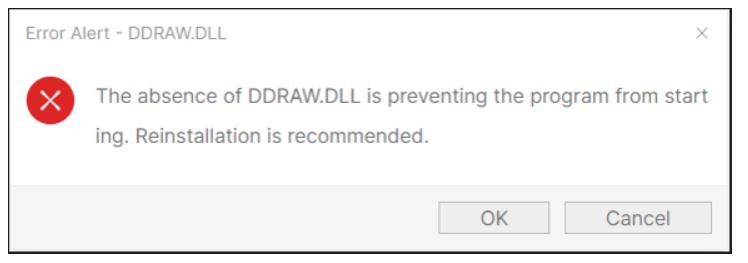
Common ddraw.dll Errors and Their Causes
Error Types and Symptoms
- "The program can't start because ddraw.dll is missing from your computer."
- "Failed to load ddraw.dll."
- "Entry point not found in ddraw.dll."
- Application crashes upon launching or during graphical operations.
Root Causes
- Corrupted or missing DLL files due to accidental deletion, malware infections, or system crashes.
- Version conflicts caused by outdated or incompatible drivers, or incompatible game patches.
- Incomplete or failed application installation, leading to missing files.
- System file corruption from improper shutdowns or hardware issues.
- Obsolete DirectX versions, especially for older games relying on specific DLL versions.
How to Fix ddraw.dll Errors Manually
Step 1: Reinstall the Game or Application
Many ddraw.dll errors resolve by reinstalling the affected game or application.
- Uninstall the program through Windows Settings.
- Download the latest installer from official sources.
- Follow the prompts to reinstall, ensuring all files are properly configured. Tip: Sometimes, reinstalling the program resets DLL references and replaces missing files.
Step 2: Download and Replace ddraw.dll Manually
If the DLL file is missing or corrupt, you can manually replace it:
- Visit the official Microsoft or trusted third-party sources such as DLL-files.com.
- Search for ddraw.dll compatible with your system architecture (32-bit or 64-bit).
- Download the DLL file.
- Copy it into the application's directory or the Windows System folder (
C:\Windows\System32orC:\Windows\SysWOW64for 64-bit systems). Note: Be cautious when downloading DLLs from third-party sites. Always prefer official sources to avoid malware.
Step 3: Use Registry Editor (RegSvr32)
Sometimes, DLL registration fixes resolve failed to load errors.
- Open Command Prompt as Administrator.
- Run the command:
regsvr32 ddraw.dll - Wait for confirmation message indicating successful registration.
Step 4: Run System File Checker (SFC) and DISM
System file corruption can affect DLL files.
- Open Command Prompt as Administrator.
- Run the System File Checker:
sfc /scannow
- Once completed, run the Deployment Image Servicing and Management (DISM) tool:
DISM /Online /Cleanup-Image /RestoreHealth
- Restart your computer after these scans to apply fixes.
Preventing Future ddraw.dll Errors
Driver Updates
Graphics drivers are integral to proper DLL operation.
- Regularly check for updates from your GPU manufacturer (NVIDIA, AMD, Intel).
- Use Windows Update feature to ensure system components are current.
Security Best Practices
- Keep your antivirus and anti-malware tools updated.
- Scan your system periodically to prevent infections that can corrupt DLL files.
Official Download Sources
- Always download games, drivers, and software from official or trusted sources.
- Avoid third-party download sites that may bundle malware or outdated files.
Conclusion
ddraw.dll errors can be disruptive but are often fixable through a series of straightforward troubleshooting steps. By understanding its role within Windows and following manual repair techniques like reinstallation, manual DLL replacement, registry fixes, and system scans, you can resolve most issues efficiently. Remember, maintaining your system with regular updates, security checks, and careful downloads is key to preventing such errors from recurring. If problems persist despite your efforts, seeking professional technical support can ensure a thorough resolution and avoid further system complications. Take Action: Don’t ignore these errors—address them promptly to keep your Windows system and gaming experience smooth and error-free!